
![1727184735162_logo new 01[1]](https://telugufunda.com/wp-content/uploads/2025/04/cropped-1727184735162_logo-new-011-1.png)
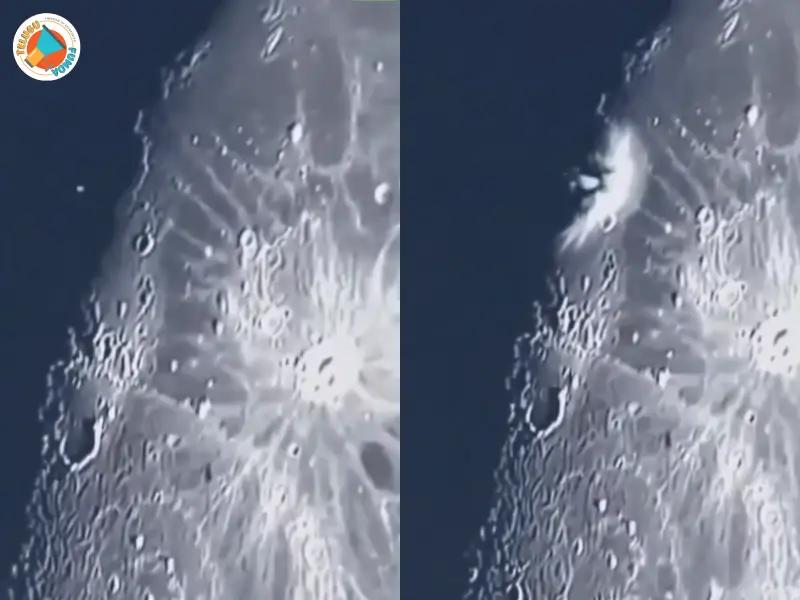
A massive four-tonne SpaceX rocket stage has reportedly crashed into the Moon after drifting through space for more than 18 months, creating a rare event that scientists believe could offer valuable insights into lunar geology and the growing challenge of space debris.
The object, roughly the size of a school bus, is believed to be the second stage of a SpaceX Falcon 9 rocket that launched Firefly Aerospace’s lunar lander in January 2025. The impact is estimated to have occurred around Wednesday noon (India time) at an incredible speed of nearly 8,690 kmph.
According to astronomers, the rocket stage struck the lunar surface near the Einstein Crater, located on the Moon’s western limb. The collision is expected to have thrown up a large plume of lunar dust and left behind a fresh impact crater. Since the region is difficult to observe directly from Earth, scientists are relying on orbiting spacecraft to capture images of the impact site.
Both NASA and South Korean lunar orbiters are expected to photograph the area in the coming days. Researchers hope the images will help determine the size of the crater and provide fresh data on how high-speed impacts affect the Moon’s surface.
Unlike most Falcon 9 second stages, which either burn up in Earth’s atmosphere or fall harmlessly into the ocean after completing their mission, this particular rocket stage remained in deep space. The January 2025 mission required additional thrust to send its payload toward the Moon, leaving the empty stage in an extended orbit after it had exhausted its fuel.
With no fuel remaining, the rocket stage could no longer be controlled. Over time, the combined effects of the Sun’s gravitational influence and the Earth-Moon system gradually altered its trajectory, eventually placing it on a collision course with the Moon.
SpaceX has clarified that the impact was completely unintentional. Company officials explained that once the stage completed its mission and depleted its fuel, it became another piece of inactive space hardware drifting through space.
Julianna Scheiman, SpaceX’s Director of NASA Science and Dragon Programs, explained that a combination of solar activity and gravitational forces ultimately pushed the rocket stage onto a path that intersected with the Moon.
Astronomers had predicted the impact months in advance after tracking the object’s orbit. Bill Gray, creator of widely used astronomical tracking software, noted that while the collision poses no danger to people or active spacecraft, it offers a rare opportunity for scientific observation.
Researchers believe the event could improve understanding of lunar impact physics, crater formation, and the behavior of artificial objects colliding with celestial bodies. The findings may also help space agencies plan future lunar missions more responsibly.
The incident has once again highlighted the increasing issue of space debris beyond Earth’s orbit. As more government agencies and private companies launch missions to the Moon, experts say careful planning will be needed to prevent unnecessary impacts and reduce long-term debris around the Earth-Moon system.
Although accidental, the Moon impact serves as a reminder of the challenges that come with expanding human activity in space. At the same time, scientists are optimistic that this unexpected collision will provide valuable information that could benefit future lunar exploration and space sustainability efforts.
Follow Telugu Funda on trending Social Media Platforms for more Cinema, OTT, Political, And Sports updates.