![1727184735162_logo new 01[1]](https://telugufunda.com/wp-content/uploads/2025/04/cropped-1727184735162_logo-new-011-1.png)
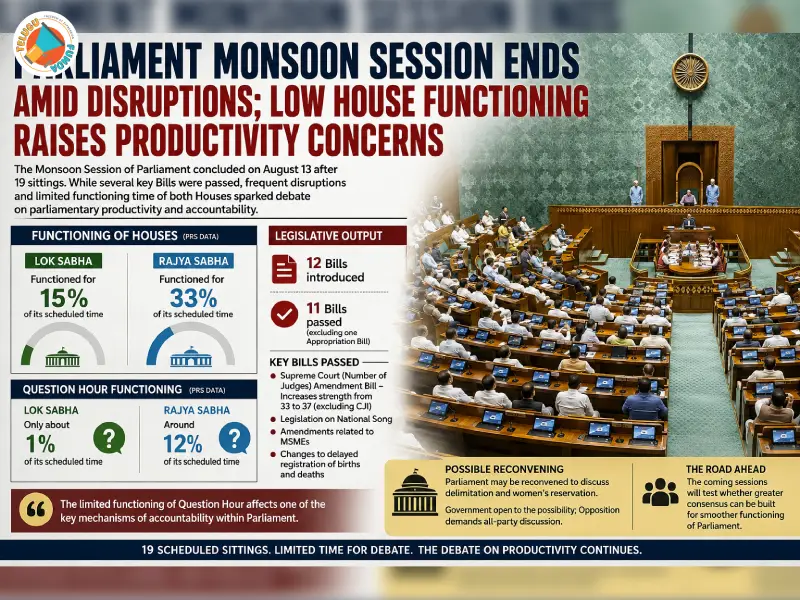
New Delhi: The Monsoon Session of Parliament concluded on August 13 after 19 sittings, with repeated disruptions and limited functioning of both Houses becoming major talking points. While the government succeeded in pushing several key Bills through Parliament, the low working hours raised concerns over legislative productivity and parliamentary scrutiny.
The session was held from July 20 to August 13, with both the Lok Sabha and Rajya Sabha scheduled to meet for 19 days. According to data compiled by PRS Legislative Research, the Lok Sabha functioned for around 15% of its scheduled time, while the Rajya Sabha recorded approximately 33% functioning.
The figures have once again brought the issue of parliamentary productivity into focus, particularly amid frequent adjournments and political disagreements between the government and Opposition.
Question Hour Sees Major Disruptions
One of the most significant concerns was the limited functioning of Question Hour, an important mechanism through which MPs hold the government accountable.
PRS data shows that Question Hour functioned for only about 1% of its scheduled time in the Lok Sabha and around 12% in the Rajya Sabha during the session. Repeated disruptions and adjournments affected the opportunity for MPs to raise questions directly with ministers on government policies and implementation.
Government Pushes Ahead With Legislative Agenda
Despite the disruptions, Parliament passed several pieces of legislation during the session. PRS recorded 12 Bills being introduced and 11 Bills being passed, excluding one Appropriation Bill.
The legislative agenda covered areas including taxation, business regulation, judicial strength, registration of births and deaths, and other policy matters.
Among the key legislation passed was the Supreme Court (Number of Judges) Amendment Bill, which increases the sanctioned strength of Supreme Court judges, excluding the Chief Justice of India, from 33 to 37.
Parliament also passed legislation concerning the national song and amendments related to micro, small and medium enterprises. Changes were also made to provisions dealing with delayed registration of births and deaths.
Government and Opposition Remain Divided
The session witnessed sharp differences between the government and Opposition over several issues. Opposition parties sought discussions on matters they considered important, while the government continued with its listed legislative programme.
The government maintained that it was able to advance its legislative agenda despite the disruptions. Opposition parties, meanwhile, argued that important national issues deserved adequate parliamentary discussion and scrutiny.
The developments have once again highlighted the challenge of balancing the government’s responsibility to pass legislation with the Opposition’s role in questioning policies and examining proposed laws.
Delimitation and Women’s Reservation May Bring Parliament Back
Another major issue emerging after the session is the possibility of Parliament being reconvened to discuss matters linked to delimitation and women’s reservation.
Parliamentary Affairs Minister Kiren Rijiju has indicated that Parliament could potentially be reconvened for discussions on the matter. Congress president Mallikarjun Kharge has also called for an all-party discussion, putting the issue at the centre of the political conversation.
What the Session Means for Parliamentary Functioning
Parliamentary disruptions are not new, but the sharply reduced functioning time during the 2026 Monsoon Session has renewed questions about the effectiveness of legislative proceedings.
The importance of parliamentary productivity extends beyond the number of Bills passed. Parliamentary debate allows lawmakers to examine legislation, raise concerns, seek clarifications and scrutinise government decisions.
The session has therefore produced two contrasting narratives. On one side, the government managed to pass several Bills and maintain its legislative agenda. On the other, the limited functioning of both Houses reduced the time available for detailed debate and Question Hour.
As Parliament prepares for its upcoming sessions, the focus is likely to remain on whether the government and Opposition can reach greater agreement on the conduct of parliamentary business.
For now, the 2026 Monsoon Session stands out for the striking gap between the 19 scheduled sittings and the relatively limited time during which the two Houses functioned effectively.
Follow Telugu Funda on trending Social Media Platforms for more Cinema, OTT, Political, And Sports updates.