
reviews

Punchline

Thella Kaagitham attempts to tackle a sensitive teenage issue with a socially relevant message, but the film struggles to translate its core idea into engaging drama. Despite a passable first half-hour and a confident debut from Bogapathi Nakshatra, the repetitive second half, excessive melodrama and stretched conflict make the film a tedious watch.

Storyline

The film revolves around a teenage boy (Harsh Roshan) and a teenage girl (Bogapathi Nakshatra) who fall in love during their eleventh grade and eventually get intimate. Their lives take an unexpected turn when they are forced to deal with the consequences of their decision.

The story follows their attempts to handle the situation, the fear of informing their parents and the problems that arise as they search for a way out. The film ultimately focuses on the importance of teenagers approaching their parents when they find themselves in difficult situations.

Positives

Passable first 30 minutes
Bogapathi Nakshatra’s confident debut
Ajay’s performance, particularly in the climax
A socially relevant core message
A few good locations captured by the cinematography

Negatives

Tedious second half
Excessive melodrama
Repetitive sequences
Poor music and background score
Conflict point is stretched far beyond what the story can sustain
Comedy does not land consistently
Several characters are underutilised

Technicalities

Vijay Bulganin, who has delivered memorable music for romantic films in the past, disappoints here. None of the songs leave a lasting impression, while the background score also fails to elevate the emotional moments.

Nandu Savarigana’s writing is ordinary, with only a couple of dialogues standing out. The screenplay becomes increasingly repetitive once the central conflict is introduced, making the second half particularly difficult to sit through.

K. V. Guhan’s cinematography is functional and suits the film’s setting. Some of the lush green locations are captured well. Karrhika Srinivas’ editing, however, is a major drawback, especially in the second half, where the film desperately needed tighter pacing.

Director Ramesh Bandreddy deserves credit for attempting to address an important issue involving teenagers and the need for better communication between children and parents. However, the film’s execution falls short. Instead of allowing the message to emerge naturally through the story, the director relies on a voice-over towards the end to explicitly state the intended takeaway.

The film’s initial portions establish the teenage romance reasonably well, but once the main conflict arrives, the narrative gets stuck. The couple repeatedly tries to solve the problem, while the story takes too long to move forward. The lack of strong emotional involvement makes it difficult for the audience to empathise with their situation.

Telugu cinema has explored teenage romance before, with films such as Kotha Bangaru Lokam successfully balancing innocent romance, comedy, music and emotion. Thella Kaagitham deals with a somewhat similar underlying issue, but fails to achieve the same balance. The repeated situations, forced comedy and excessive melodrama ultimately weaken the film.

Harsh Roshan, who was impressive in Court: State vs a Nobody, appears noticeably restrained here. While he has a few decent moments, his overall performance lacks the natural ease seen in his previous film. Bogapathi Nakshatra, on the other hand, makes a confident debut. She looks good, performs well and has a noticeable screen presence.

Ajay delivers a solid performance as a strict but caring father, with his work in the climax being particularly effective. Saranya and Raj Kumar Kasireddy are adequate in their supporting roles, while Deepak Mali manages to generate a few laughs. Goparaju Ramana’s character, however, is underwritten and leaves little impact.

Rating

2.25/5

Final Verdict

Thella Kaagitham starts with a reasonably interesting setup but loses its way once the main conflict begins. The socially relevant message is worthy, but the stretched screenplay, repetitive sequences, weak music and excessive melodrama turn the film into a tedious experience.

Follow Telugu Funda on trending Social Media Platforms for more Cinema, OTT, Political, And Sports updates.

Punchline

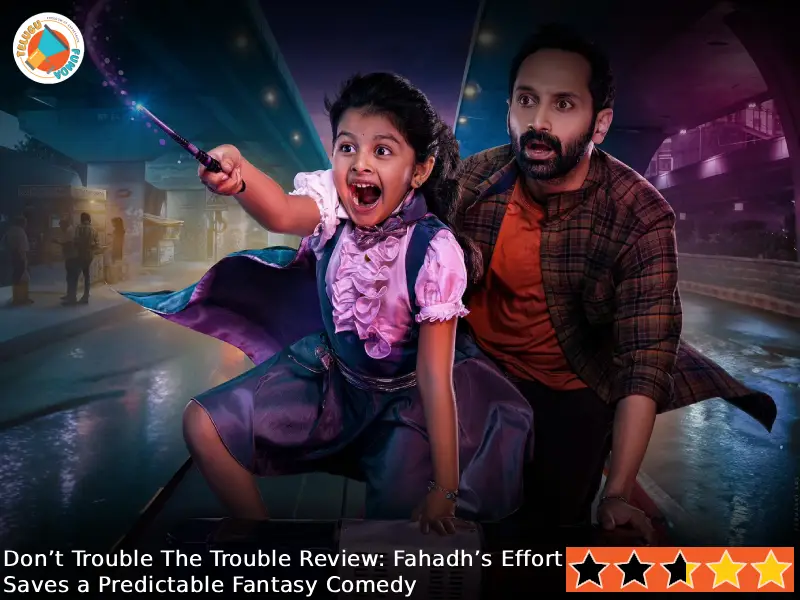
Don’t Trouble the Trouble attempts to blend fantasy, comedy and an emotional road adventure, with Fahadh Faasil leading the show alongside young actor Ssara Palekar. While the unusual premise and lead performances offer some enjoyable moments, the film struggles to maintain momentum and emotional impact.

Storyline

Soori (Fahadh Faasil) is an orphan who survives by pulling off clever schemes for quick money. After crossing paths with gangster Aslam Bhai (Mahesh Manjrekar), he lands in serious trouble and is given just two days to arrange ₹25 lakh.

During his desperate search for money, Soori meets Divya (Ssara Palekar), a runaway girl from a wealthy family. Believing Soori to be a powerful magician, Divya asks him to help her. Seeing an opportunity to escape his financial troubles, Soori decides to accompany her.

What begins as a convenient arrangement gradually turns into an unexpected journey as Soori discovers the truth behind Divya’s situation. The rest of the story revolves around their unusual bond, the challenges they encounter and Soori’s gradual change in perspective.

Positives

Fahadh Faasil delivers a sincere and energetic performance.
His comic timing and expressive reactions work well.
His Telugu dialogue delivery is impressive.
Ssara Palekar makes a confident and endearing Telugu debut.
The combination scenes between Fahadh, Ssara, and the beagle are entertaining.
Mahesh Manjrekar makes an impact despite limited screen time.
Saurabh Sachdeva’s unconventional character adds some curiosity.
Kaala Bhairava’s background score adds energy to the lighter moments.

Negatives

The trailers reveal much of the core plot, reducing the surprise factor.
The screenplay struggles to maintain consistent interest.
The central conflict is too thin and becomes predictable early.
The emotional core arrives too late in the narrative.
The second half becomes slow and repetitive.
The police investigation track fails to add much value.
Some comedy relies on repetitive gags.
There are noticeable logical inconsistencies.
Several supporting characters are underutilised.
The editing could have been sharper, with some dragging sequences needing trimming.

Technicalities

Director Shashank Yeleti shows ambition in attempting a fantasy comedy with a fairy-tale flavour, but the execution falls short in several areas. The writing by Hamza Ali needed more depth and stronger emotional beats to make the premise more engaging.

Brad Francis’ cinematography captures the urban backdrop neatly, while Kaala Bhairava’s background score adds energy to the lighter sequences.

Praveen Antony’s editing could have been tighter. Several scenes feel stretched and could have benefited from sharper trimming. The production values are decent and suit the scale of the film.

Rating

2.75/5

Final Verdict

Don’t Trouble the Trouble is an uneven fantasy comedy that delivers entertainment in patches. Fahadh Faasil carries the film with a committed performance, while Ssara Palekar makes a pleasant impression in her Telugu debut. However, predictable writing, a slow second half, repetitive comedy, and weak emotional stakes hold the film back. Children may connect better with its lighthearted magical premise, while adult viewers may find only a few portions genuinely engaging.

Follow Telugu Funda on trending Social Media Platforms for more Cinema, OTT, Political, And Sports updates.
Punchline

Jai Krishna Ghattamaneni and Rasha Thadani make impressive debuts, but routine storytelling keeps Srinivasa Mangapuram from reaching its full potential.

Storyline

Sreenu (Jai Krishna Ghattamaneni) lands in Tirupati and soon comes across the notorious gangster Peddi Reddy (Kick Shyam). During a visit to a temple, he falls in love at first sight with Peddi Reddy’s daughter, Manga (Rasha Thadani). While Manga gradually becomes friends with Sreenu, she doesn’t share his romantic feelings. As the narrative unfolds, Sreenu’s mysterious past and his connection with Venkatappayya Naidu (Mohan Babu) come to light. Whether Sreenu wins Manga’s love and how his past changes everything forms the core of the story.

Positives

Jai Krishna Ghattamaneni delivers a confident and impressive debut performance.
Rasha Thadani shines in her Telugu debut, especially in emotional scenes, while her Telugu dialogue delivery deserves appreciation.
The chemistry between the lead pair works well and keeps the film engaging.
Jai Krishna handles both the romantic and action-packed portions with ease.
Mohan Babu, Brahmaji, Vasuki, and the supporting cast provide solid performances.
The visuals beautifully capture the spiritual charm and authentic locations of Tirupati.

Negatives

The biggest drawback is the predictable storyline and familiar twists.
Director Ajay Bhupathi’s signature unconventional storytelling is largely missing.
The first half lacks engaging moments and could have been much tighter.
The emotional impact in the second half suffers because the setup isn’t strong enough.
Despite promising performances, the screenplay doesn’t offer enough memorable moments.

Technicalities

GV Prakash Kumar’s soundtrack blends well with the narrative, and the background score effectively enhances several important scenes. Cinematographer Jayakrishna Gummadi deserves praise for capturing Tirupati’s beauty with impressive visuals. The editing is neat, the production values are rich, and the action sequences are well choreographed. While Ajay Bhupathi presents the newcomers confidently, his direction lacks the freshness expected from him.

Rating

2.75/5

Final Verdict

Srinivasa Mangapuram is a decent one-time watch that mainly succeeds because of its talented debutants. Jai Krishna Ghattamaneni announces himself confidently with a strong screen presence, while Rasha Thadani leaves a positive first impression in Telugu cinema. However, the film ultimately falls short due to its routine narrative, predictable twists, and lack of emotional depth. If you’re interested in watching two promising newcomers, this film is worth a look, but don’t expect a fresh or gripping story.

Follow Telugu Funda on trending Social Media Platforms for more Cinema, OTT, Political, And Sports updates.
Punchline

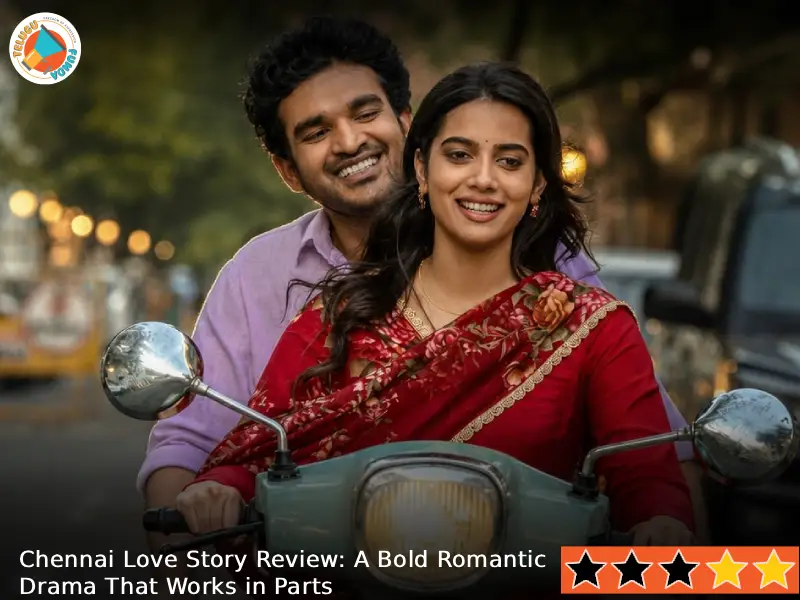
Chennai Love Story attempts a fresh take on romance with an emotionally complex premise. While the first half impresses with heartfelt moments and soulful music, the second half’s lighter treatment may not connect with every viewer.

Storyline

Nivedita (Sri Gouri Priya) is left emotionally shattered after a life-changing incident. Hoping to help her heal, her friends take her to Chennai. There, she meets Steven Shankar (Kiran Abbavaram), an orphan who dreams of becoming a successful film director. Though they initially don’t get along, love gradually blossoms between them. Just when life seems to be falling into place, another unexpected event changes everything, putting their relationship to the ultimate test.

Positives


The first half is engaging with well-written romantic moments and emotional depth.
Mani Sharma’s soulful music beautifully enhances the narrative.
Sri Gouri Priya delivers a standout performance, especially in emotionally demanding scenes.
Kiran Abbavaram impresses with a restrained and mature performance, making his character believable.
The chemistry between the lead pair works well and keeps the audience invested.
Meaningful lyrics blend seamlessly into the storytelling.

Negatives


The major interval twist loses its impact due to being revealed before release.
The second half shifts to a lighter, comedy-driven tone that may not suit the film’s emotional premise.
Several emotional scenes feel underdeveloped and end without proper closure.
Certain characters, particularly the heroine’s mother, are written in a predictable and clichéd manner.
The climax becomes fairly predictable despite fitting the story.

Technicalities

Mani Sharma’s music is one of the film’s biggest strengths, elevating several emotional moments. Viswas Daniel captures Chennai’s coastal beauty with pleasing visuals. The production values are decent, but the editing could have been tighter, especially in the second half. Director Ravi Namburi deserves credit for choosing a challenging subject and handling it with reasonable sincerity, even if the execution isn’t consistently impactful.

Rating

3/5

Final Verdict

Chennai Love Story is a decent romantic drama that dares to explore a sensitive and unconventional concept. Strong performances by Kiran Abbavaram and Sri Gouri Priya, along with Mani Sharma’s impressive music, make the film worth watching. However, the uneven second half and predictable narrative prevent it from becoming a memorable romantic entertainer. Those looking for a romance with a different premise can give it a watch.

Follow Telugu Funda on trending Social Media Platforms for more Cinema, OTT, Political, And Sports updates.

Punchline

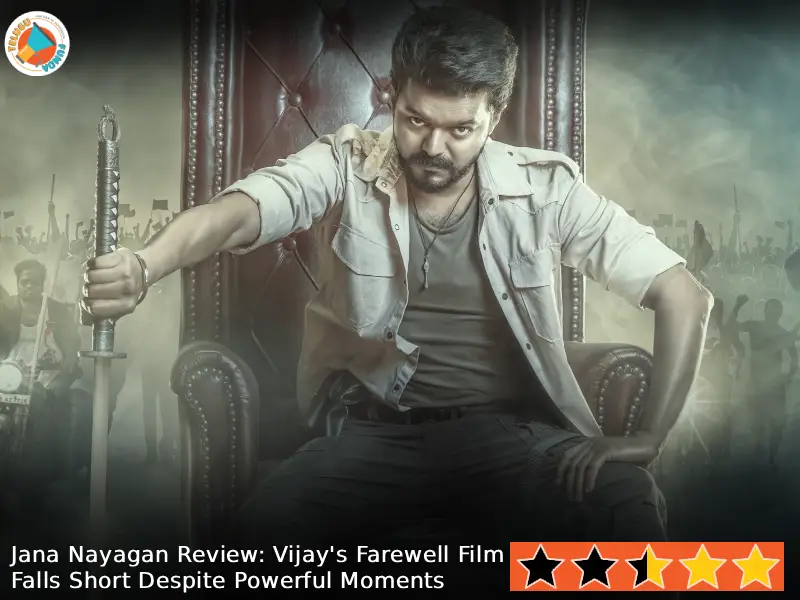
Vijay shines in a few emotionally charged and mass-appeal moments, but an overstuffed screenplay, weak antagonist track, and excessive political references prevent Jana Nayagan from becoming the memorable farewell it aimed to be.

Storyline

Jana Nayagan follows the journey of Vetri Kondan (Vijay), a former police officer who becomes the guardian of a young woman (Mamitha Baiju) suffering from PTSD. Determined to help her become independent, he encourages her to fulfill her dream of joining the Indian Army.

As the story unfolds, Vetri Kondan’s mysterious past, his imprisonment, and his rivalry with the ruthless John Himlar (Bobby Deol) come to light. The film revolves around how Vetri Kondan confronts the villain’s dangerous plans under “Operation Meluga” while inspiring the young woman to overcome her fears.

Positives

Vijay delivers an energetic performance, especially during the flashback portions.
The flashback episode featuring Vetri Kondan is the biggest highlight of the film.
The Good Touch & Bad Touch sequence is handled with sensitivity and leaves a strong impact.
Mamitha Baiju impresses with a sincere performance in an emotionally demanding role.
A couple of Anirudh’s songs elevate Vijay’s mass moments effectively.

Negatives

Bobby Deol’s antagonist role lacks proper depth and fails to create any real impact.
Action sequences feel repetitive and are weakened by poor AI-generated visuals.
Excessive political references slow down the narrative.
Emotional moments fail to connect consistently.
The screenplay becomes dull and predictable in several portions.
The newly added subplots dilute the strength of the original Bhagavanth Kesari story.

Technicalities

Director H. Vinoth attempts to blend the original story with fresh political and commercial elements, but the execution fails to deliver. While the flashback portions work well, the rest of the screenplay struggles to maintain momentum.

Anirudh Ravichander’s music is below his usual standards, although a few songs and background score moments stand out. Cinematography, editing, production design, visual effects, and action choreography are surprisingly underwhelming, making the film feel rushed and inconsistent.

Rating

2.25/5

Final Verdict

Jana Nayagan had all the ingredients to become a memorable farewell for Vijay’s acting career, but the decision to deviate from the proven screenplay of Bhagavanth Kesari ultimately works against the film. Vijay delivers a few crowd-pleasing moments, particularly in the flashback and emotional scenes, but they are not enough to overcome the weak villain, lifeless action blocks, and uninspiring screenplay. As a result, Jana Nayagan ends up being an underwhelming send-off for one of Tamil cinema’s biggest stars.

Follow Telugu Funda on trending Social Media Platforms for more Cinema, OTT, Political, And Sports updates.
Punchline

Alpha is an ambitious spy thriller that boasts lavish production values and stylish action, but weak writing, an uninspiring screenplay, and a controversial narrative make it the weakest film in the YRF Spy Universe.

Storyline

Lt. Colonel Fateh Singh Lakhawat (Bobby Deol), devastated by the heavy losses suffered during the Kargil War, conceives a secret mission called Project Alpha to strengthen India’s future security. However, the government shuts down the operation and demotes him. Unwilling to abandon his vision, Fateh secretly continues the mission, with Sita (Alia Bhatt) eventually becoming a crucial part of his plan. The film follows Sita’s journey as she carries forward Project Alpha while uncovering the truth behind Fateh’s controversial mission.

Positives

YRF once again delivers grand production values with visually appealing action sequences.
The visual effects are a noticeable improvement compared to some recent entries in the franchise.
Sharvari performs convincingly in the action scenes despite having limited screen time.
The face-off between Alia Bhatt and Sharvari stands out as one of the better action moments.
Bobby Deol delivers a sincere performance, while Anil Kapoor is dependable in his supporting role.

Negatives

The screenplay is slow, predictable, and lacks the excitement expected from a spy thriller.
The central twist feels heavily inspired by recent films but fails to create any impact.
The narrative presents India’s intelligence agencies and the Army in an unconvincing and controversial manner, weakening the emotional core.
Alia Bhatt, despite being a talented actress, appears miscast in a full-fledged action role and struggles to make the action sequences believable.
The film relies too much on glamour and stylish visuals while neglecting storytelling and character development.
Even with a relatively short runtime, the movie feels repetitive and emotionally disconnected.
The much-hyped cameo fails to generate excitement and ends up feeling underwhelming.

Technicalities

The production design and overall scale are impressive, giving the film a polished look. Rubais’ cinematography captures the action sequences effectively, while the VFX is better than expected. However, the songs leave little impression, and the background score lacks the intensity required for a spy thriller. Aarif Sheikh’s editing cannot overcome the sluggish pacing. Director Shiv Rawail, who previously impressed with The Railway Men, fails to recreate that magic here, delivering a film that lacks both emotional depth and engaging storytelling.

Rating

2/5

Final Verdict

Alpha turns out to be a major disappointment and arguably the weakest installment in the YRF Spy Universe. While the film offers impressive visuals and a few well-executed action moments, its weak screenplay, questionable writing choices, uninspiring performances in key moments, and lack of emotional engagement overshadow its strengths. Stylish presentation alone cannot compensate for the absence of a compelling story, making Alpha a forgettable spy thriller that struggles to justify its place in the franchise.

Follow Telugu Funda on trending Social Media Platforms for more Cinema, OTT, Political, And Sports updates.
Punchline

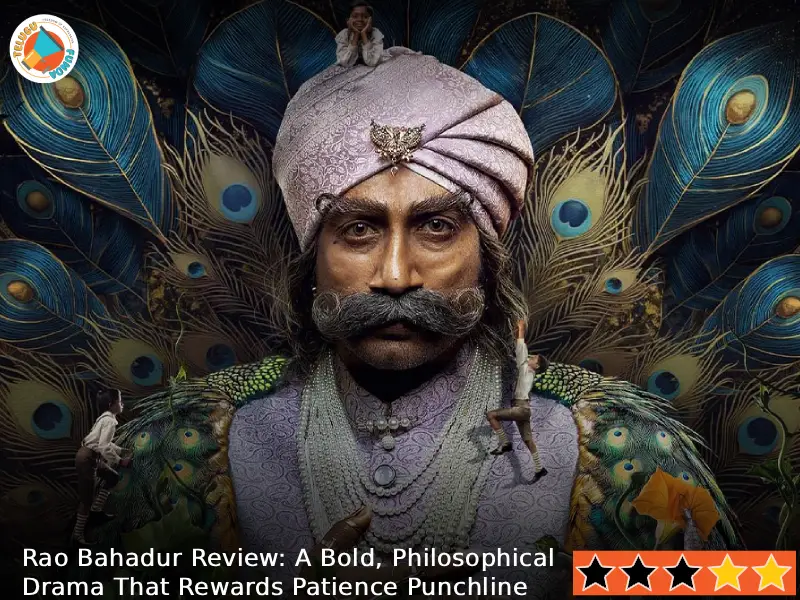
Rao Bahadur is a rare Telugu film that dares to be different. Blending satire, magical realism, and philosophical themes, director Venkatesh Maha delivers an unconventional cinematic experience that may not appeal to everyone but leaves a lasting impact on those who embrace its unique storytelling.

Storyline

Doctors are summoned to treat Ramappa Rao Bahadur (Satyadev), a descendant of a royal family who lies on his deathbed. Though considered a medical miracle, Ramappa suffers from severe psychological issues. As the narrative unfolds, the mystery behind his condition slowly comes to light, revealing a story deeply rooted in bloodline, inherited beliefs, and generational prejudice.

Set between 1968 and 1991, the film explores how society’s obsession with lineage, caste, skin colour, and social status shapes individuals across generations.

Positives

Venkatesh Maha presents a refreshingly original and thought-provoking narrative that stands apart from mainstream Telugu cinema.
The second half is highly engaging, with the climax delivering a powerful emotional and philosophical payoff.
The film successfully blends humour, satire, symbolism, and magical realism without becoming preachy.
Satyadev delivers one of his finest performances, effortlessly balancing arrogance, vulnerability, humour, and emotional depth.
The actress playing Achamma steals several scenes with her natural comic timing and memorable screen presence.
Deepa Thomas fits perfectly as Renuka, while Vikas Muppala impresses in the pivotal role of Achari.
Several dialogues and symbolic moments leave a lasting impression, especially the “Pedda Manishi” dialogue, Renuka’s act of resistance, Kusuma Raju’s birthday sequence, and the Sanjay Gandhi episode.

Negatives

The opening thirty minutes are slow and require considerable patience.
The abstract storytelling and magical realism may not connect with audiences expecting a commercial entertainer.
The overall runtime feels slightly lengthy.
The film caters more to niche viewers than mass audiences.

Technicalities

Samaran Sai’s background score perfectly complements the film’s mood without overpowering the narrative. The cinematography beautifully captures both the mystical atmosphere and the period setting, while the production design authentically recreates the 1968–1991 timeline. The overall production values remain consistently impressive and support the film’s unique vision.

Rating

3/5

Final Verdict

Rao Bahadur is a bold and unconventional film that prioritizes ideas over commercial formulas. While its slow-paced first half and abstract narrative may test the patience of mainstream audiences, the engaging second half and outstanding climax make it a rewarding experience. Powered by Venkatesh Maha’s imaginative writing and Satyadev’s exceptional performance, Rao Bahadur is a must-watch for lovers of offbeat, thought-provoking cinema, even if its appeal remains limited among mass audiences.

Follow Telugu Funda on trending Social Media Platforms for more Cinema, OTT, Political, And Sports updates.
Punchline

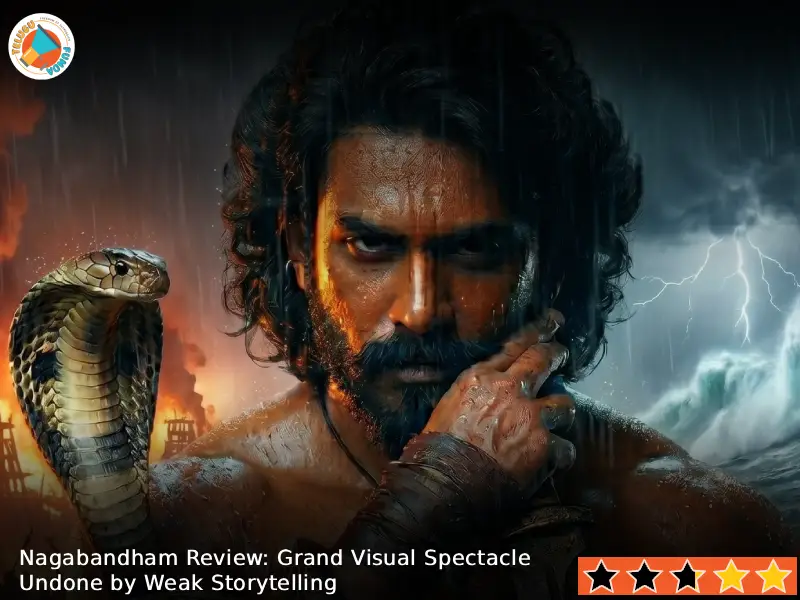
A visually lavish mythological adventure that impresses with scale but lacks the emotional depth and gripping narrative needed to make a lasting impact.

Storyline

Nagabandham follows the quest for the mystical Nagabandham, a sacred gateway said to hide an ancient treasure. The ruthless Abdali seeks two powerful artifacts the Brahmakamalam and a sacred manuscript to unlock it. Standing in his way is Rudra, a powerful guardian determined to protect the treasure at any cost. Their battle forms the foundation of this mythological action drama.

Positives

Stunning production values with lavish sets and rich visuals.
Impressive cinematography that enhances the film’s grand scale.
Virat Karrna delivers a sincere performance in his dual roles and shines in action sequences.
Rishabh Sawhney makes for a powerful and intimidating antagonist.
Nabha Natesh looks elegant on screen.
The song “Namore” stands out, while the overall production design deserves appreciation.

Negatives

The story and screenplay fail to match the film’s massive scale.
Relies heavily on the Sanatana Dharma theme without offering anything fresh.
Emotional connection with the protagonist is missing.
Excessive runtime of over three hours makes the narrative feel exhausting.
Repetitive massacre sequences slow down the pace.
Weak editing results in several unnecessary stretches.
Forced romantic track and predictable storytelling reduce the overall impact.
Many supporting actors are underutilized.

Technicalities

The makers deserve credit for mounting the film on a massive budget without compromising on production quality. Soundararajan’s cinematography, the art direction, and the production design are among the film’s strongest aspects. While the visuals are impressive, the CGI is inconsistent in places. Junaid Kumar and Abhe deliver a decent soundtrack, with “Namore” emerging as the highlight, while the background score remains average. Director Abhishek Nama succeeds in creating grandeur but falls short in crafting a compelling screenplay.

Rating

2.75/5

Final Verdict

Nagabandham is a technically rich and visually ambitious mythological adventure that promises a grand cinematic experience. However, weak writing, an overlong runtime, predictable storytelling, and a lack of emotional engagement prevent it from reaching its full potential. Those who enjoy large-scale fantasy spectacles may appreciate its visuals, but audiences looking for a gripping story may leave disappointed.

Follow Telugu Funda on trending Social Media Platforms for more Cinema, OTT, Political, And Sports updates.

Recent Posts

Categories