
admin

Lionel Messi has officially called time on his Argentina career, bringing an emotional end to one of the greatest international journeys in football history.

After more than two decades representing Argentina, Messi has announced his retirement from international football following the team’s heartbreaking 1-0 defeat to Spain in the 2026 FIFA World Cup final.

The 39-year-old confirmed his decision on social media after reportedly giving the matter considerable thought. While admitting that walking away from Argentina was a painful decision, Messi believes the time has come to make way for the next generation.

Messi made his Argentina senior-team debut in 2005 and went on to become the most influential player in the country’s modern football history. He finished his international career with 207 appearances and 125 goals, while featuring in an incredible six FIFA World Cups.

For much of his career, Messi faced criticism for failing to win a major international trophy with Argentina. That narrative finally changed in 2021 when he guided Argentina to Copa America glory.

A year later, Messi achieved the biggest prize of his career by leading Argentina to the 2022 FIFA World Cup title in Qatar. He added another major international trophy in 2024 when Argentina successfully defended their Copa America crown.

The 2026 World Cup offered Messi one final opportunity to end his international career with another world title. Argentina reached the final but suffered a narrow 1-0 defeat against Spain after extra time. The match ultimately became Messi’s final appearance in an Argentina shirt.

In his retirement message, Messi also praised Argentina’s emerging generation of players, saying they deserve their opportunity to represent the national team. Despite stepping away, he made it clear that his love for Argentina will never change.

Messi’s Football Journey Isn’t Over Yet

While his international career has come to an end, Messi is not retiring from professional football altogether. The Argentine superstar continues to play club football for Inter Miami, with his current contract extension running through the 2028 MLS season.

From painful defeats in major finals to finally lifting the Copa America and World Cup trophies, Messi’s Argentina journey has delivered unforgettable moments.

After 21 years, six World Cups and 125 international goals, one of football’s greatest international careers has reached its emotional conclusion.

Follow Telugu Funda on trending Social Media Platforms for more Cinema, OTT, Political, And Sports updates.
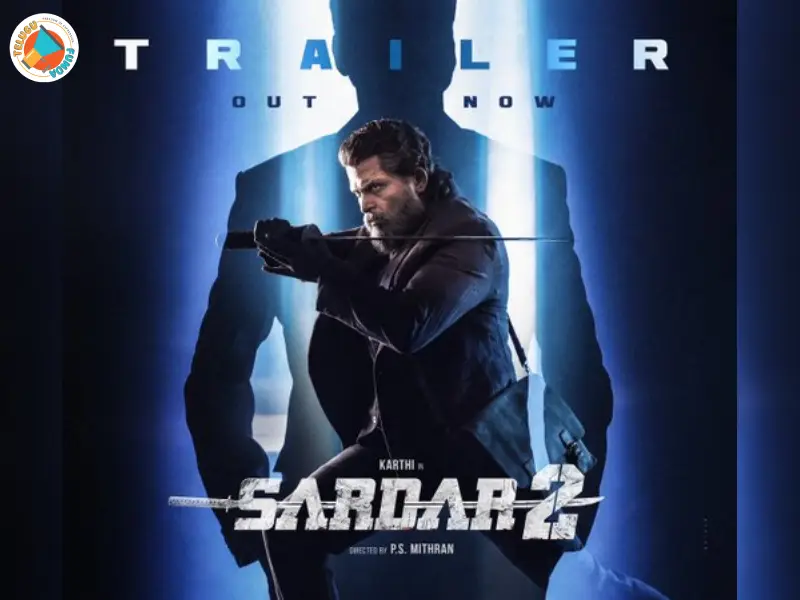
Karthi’s Sardar 2 is ready to take the action quotient several notches higher. The makers have unveiled the theatrical trailer for the much-awaited sequel to the 2022 blockbuster Sardar, and it promises a grand, stylish and high-octane cinematic experience.

The trailer showcases Karthi in multiple looks, delivering powerful performances, intense action sequences and punchy dialogues. Director P.S. Mithran appears to have expanded the scale of his storytelling, taking the franchise into a more international arena with bigger visuals, ambitious action and an intriguing spy-thriller backdrop.

The film’s visuals, background score and action choreography stand out in the trailer, creating an edge-of-the-seat atmosphere. At the same time, the story appears to delve deeper into the emotional side of its protagonist, with the guilt and psychological burden of a spy emerging as an important element.

Adding more excitement to the sequel is SJ Suryah, who plays the antagonist. His intense screen presence and the apparent mind games between his character and Karthi’s protagonist could become one of the film’s biggest highlights.

With its combination of mass action, spy thrills, stylish presentation and a strong face-off between Karthi and SJ Suryah, Sardar 2 looks like a major theatrical entertainer.

Malavika Mohanan and Ashika Ranganath play the female leads, while Sam C.S. is composing the music. The film is gearing up for a grand theatrical release on September 10.

Follow Telugu Funda on trending Social Media Platforms for more Cinema, OTT, Political, And Sports updates.
Andhra Pradesh is witnessing a fresh political battle over credit as the first phase of the historic Veligonda Project is set to be inaugurated by Chief Minister N. Chandrababu Naidu on Monday. While the coalition government is presenting the project as a major irrigation milestone, former Chief Minister YS Jagan Mohan Reddy has claimed that the credit for its completion largely belongs to his father, the late YS Rajasekhara Reddy, and his YSR Congress Party government.

Jagan Claims Credit for Veligonda Project

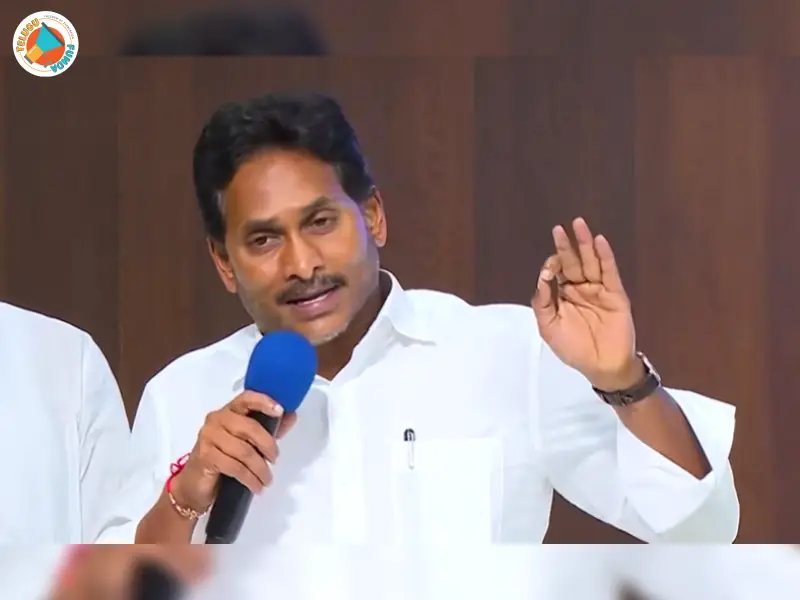
Jagan took to X with a detailed post highlighting the history of the Veligonda project and seeking to attribute much of its progress to successive YSR-led governments.

He pointed out that the project was originally conceived decades ago and alleged that despite the foundation stone being laid during Chandrababu Naidu’s earlier tenure in 1996, significant progress remained limited for several years.

According to Jagan, the Jala Yagnam initiative launched during YS Rajasekhara Reddy’s tenure played a crucial role in developing the project’s core infrastructure, including dams, canals and the twin underground tunnels.

Jagan Highlights Final Tunnel Work

Jagan also claimed credit for his own government, stating that it undertook one of the most challenging remaining components of the project the excavation of the final 10.5 kilometres of the twin tunnels.

He argued that these works were crucial to bringing the long-pending project closer to completion and questioned the coalition government’s claims surrounding the project.

R&R Issue Becomes Another Flashpoint

The former Chief Minister also criticised the Chandrababu Naidu-led government over the Rehabilitation and Resettlement (R&R) process.

Jagan alleged that the government had failed to adequately address the concerns of displaced villagers for more than two years, leaving some families waiting for compensation. He accused the ruling alliance of focusing on publicity while seeking credit for a project developed over multiple governments.

Chandrababu Government Pushes Project Towards Finish Line

The ruling coalition, however, maintains that its government played a critical role in removing the remaining hurdles and taking the Veligonda project towards completion.

In recent months, the government has reportedly invested more than ₹2,400 crore on essential works, including feeder canals, head regulators and canal lining.

The administration has also focused on clearing long-pending R&R packages, with compensation being disbursed to displaced families. The government has positioned these measures as essential steps to enable the reservoir to be filled while addressing the concerns of affected communities.

Veligonda Project Turns Into Political Credit Battle

The Veligonda Project is now more than an irrigation milestone it has become another major political credit battle between the TDP-led coalition and YSRCP.

With Chandrababu Naidu set to inaugurate the first phase, the coalition government is highlighting the expenditure and final-stage works completed under its tenure, while Jagan is stressing the contributions of YS Rajasekhara Reddy and his own administration.

The project is expected to provide drinking water to fluoride-affected villages and support irrigation across thousands of acres in the drought-prone regions of Prakasam, Markapuram, Nellore and Kadapa, making its completion politically and economically significant for Andhra Pradesh.

Follow Telugu Funda on trending Social Media Platforms for more Cinema, OTT, Political, And Sports updates.

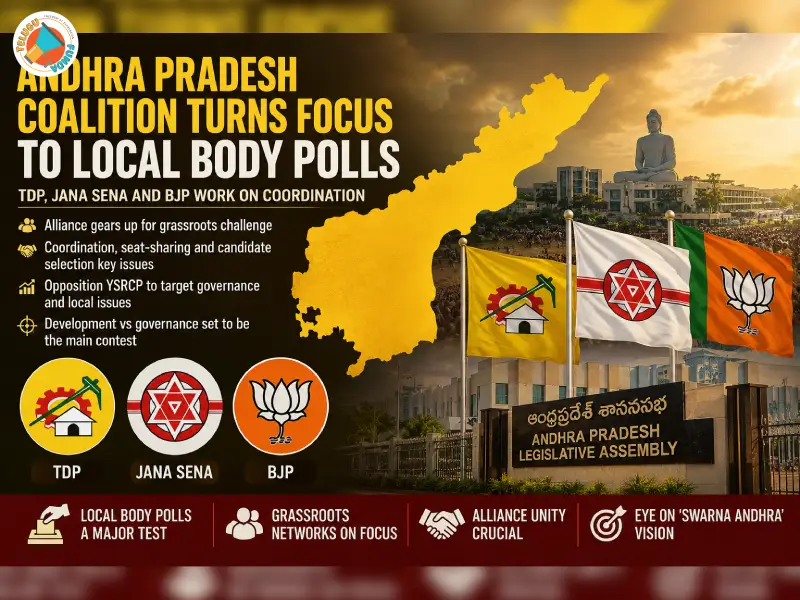
Amaravati: The ruling alliance in Andhra Pradesh, comprising the Telugu Desam Party (TDP), Jana Sena Party and Bharatiya Janata Party (BJP), is shifting its political focus towards the upcoming local body elections, with coordination among the three partners emerging as a key priority.

The alliance, which came to power in the 2024 Assembly elections with the TDP as the principal partner, is now looking to extend its electoral understanding to the grassroots level. The local body polls are expected to test not only the alliance’s popularity but also its organisational coordination across villages, mandals, municipalities and urban local bodies.

For the coalition partners, the elections will be important in strengthening their grassroots networks and establishing local leadership ahead of future political contests. However, managing differences among party cadres and local leaders could prove to be a major challenge.

BJP leader P V N Madhav recently acknowledged that there was some dissatisfaction among cadres of the TDP, Jana Sena and BJP. He stressed the need to address such concerns and improve coordination before the local elections.

The issue is significant because political competition at the local level can be more complicated than in Assembly elections. While the three parties may remain alliance partners at the state level, their local leaders could have competing political ambitions and support bases.

Candidate selection and seat-sharing are therefore expected to become crucial issues. The alliance may have to work out arrangements at the village, mandal and municipal levels to avoid direct contests between leaders belonging to different coalition partners.

The TDP remains the largest partner with a broad organisational presence across the state. Jana Sena has its own support base under the leadership of Deputy Chief Minister Pawan Kalyan, while the BJP brings its national political presence and organisational network to the alliance.

The local elections could consequently become an important opportunity for each party to assess its independent organisational strength while maintaining the broader coalition arrangement.

The YSR Congress Party (YSRCP), meanwhile, is expected to closely monitor developments within the ruling alliance and target the government over governance and local issues. Former Chief Minister YS Jagan Mohan Reddy has continued to raise concerns over issues including recruitment, drought relief and welfare implementation.

Recruitment controversies, including allegations surrounding DSC and Group I processes, could also feature in the Opposition’s campaign. Jagan has sought a CBI investigation into the alleged irregularities, while the government and its leaders have rejected the Opposition’s allegations.

At the same time, the TDP-led government is likely to highlight its development agenda. Amaravati remains a major focus, with the government pushing infrastructure projects and investment initiatives as part of its broader plans for Andhra Pradesh.

The coalition is also seeking to promote its long-term development vision under the broader ‘Swarna Andhra’ agenda. The local elections could therefore develop into a contest between the government’s development narrative and the Opposition’s criticism of governance.

Maintaining unity within the alliance will be particularly important as the political contest moves from the statewide level to smaller constituencies. Local rivalries, leadership ambitions and differences over candidate selection could put pressure on the partnership.

For the ruling parties, a coordinated performance in the local body elections could strengthen the alliance’s grassroots presence and reinforce the mandate secured in the 2024 Assembly elections. Any visible differences, however, could provide the Opposition with an opportunity to challenge the coalition.

As preparations gather pace, discussions among TDP, Jana Sena and BJP leaders are likely to centre on seat adjustments, candidate selection, cadre coordination and campaign strategy.

The upcoming local body elections are thus set to become an important test of not only the ruling alliance’s electoral strength but also its ability to maintain political unity at the grassroots level.

Follow Telugu Funda on trending Social Media Platforms for more Cinema, OTT, Political, And Sports updates.
New York: Rashtriya Swayamsevak Sangh (RSS) chief Mohan Bhagwat’s planned appearance at Madison Square Garden has sparked a debate among sections of the Indian-American community, civil society groups and interfaith organisations.

Bhagwat is scheduled to address the “Universal Oneness Celebration”, organised by American Hindus for Engagement and Dialogue. Organisers are expecting a large turnout for the programme, which they have presented as an event centred on Hindu philosophy, Indian cultural heritage and social harmony.

However, Bhagwat’s planned appearance has drawn criticism because of the RSS’s ideological and political significance in India. The organisation is widely seen as an influential force within the country’s broader Hindu nationalist movement and has maintained close ideological links with the Bharatiya Janata Party (BJP).

Supporters of the event say Bhagwat’s visit represents an opportunity to highlight India’s cultural traditions and promote the message of social unity among the diaspora. They argue that the RSS and its leadership should have the space to engage with Indian-American audiences, particularly given the organisation’s prominence in contemporary Indian society.

Opponents, meanwhile, have questioned the RSS’s ideological positions and raised concerns about its influence on religious minorities in India. The criticism has extended to sections of civil society and interfaith groups in New York.

New York Mayor Zohran Mamdani has also publicly criticised the RSS’s ideology, adding another dimension to the controversy. The issue has further attracted attention within US policy circles, with the US Commission on International Religious Freedom reportedly raising concerns over Bhagwat’s visit and making suggestions involving his visa and possible measures against RSS members.

The RSS and supporters of the programme have rejected allegations that the organisation is anti-minority. They maintain that its work is centred on cultural identity, social service, national unity and strengthening society.

The dispute has consequently developed into a wider discussion about the role of Indian political, cultural and religious organisations within the United States. The Indian-American community is one of the country’s most prominent South Asian diaspora groups, and organisations representing a wide range of political and ideological viewpoints regularly organise public events.

Bhagwat’s proposed appearance has brought divisions within the diaspora into sharper focus, particularly over the interpretation of Hindu identity and the political role of organisations associated with it.

Supporters contend that the RSS reflects an important segment of Indian society and that its leaders should be able to engage with diaspora communities. Critics, on the other hand, argue that prominent US platforms should not be used to legitimise an ideology they associate with religious majoritarianism.

The controversy also reflects broader debates in the United States over political expression, religious identity, civil rights and the growing influence of diaspora organisations.

Bhagwat’s position as RSS chief has added to the significance of the event. His public appearances are closely watched both in India and overseas, and the Madison Square Garden programme is being viewed as an important moment for supporters as well as critics.

For organisers, the event is an opportunity to promote Hindu traditions and the principle of universal oneness. For opponents, it provides a platform to question the ideology and social influence associated with the RSS.

As the programme approaches, attention is likely to remain focused on attendance, Bhagwat’s remarks and the response from different sections of the Indian-American community. The controversy highlights how India’s domestic political and ideological debates increasingly extend beyond its borders, particularly through politically diverse and highly engaged diaspora communities.

Follow Telugu Funda on trending Social Media Platforms for more Cinema, OTT, Political, And Sports updates.
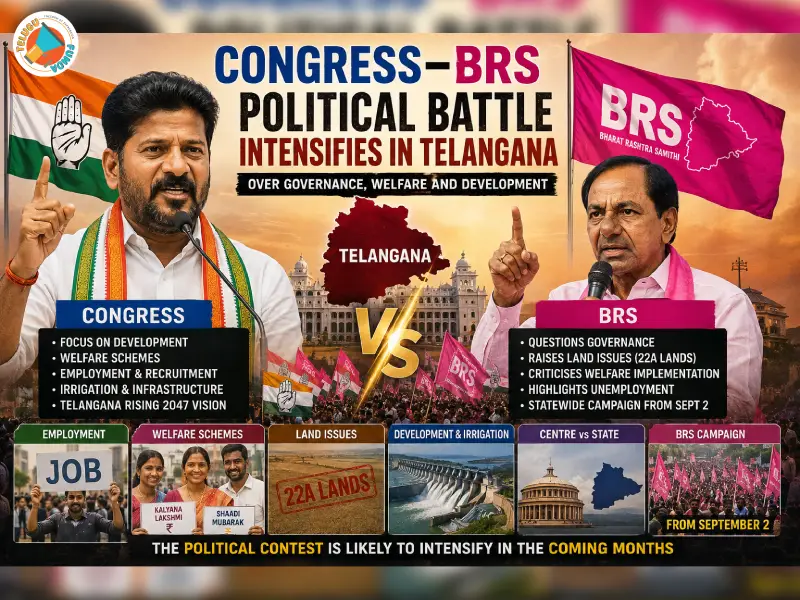
Hyderabad: The political contest between Telangana’s ruling Congress and the Opposition Bharat Rashtra Samithi (BRS) is gaining momentum, with governance, employment, welfare schemes, land issues and development emerging as key points of confrontation.

The latest phase of the political battle comes ahead of a statewide campaign announced by the BRS from September 2. The party plans to organise programmes across Telangana to highlight what it describes as failures, delays and unfulfilled promises of the Congress government.

Chief Minister A Revanth Reddy-led Congress government, meanwhile, has defended its performance and continued to focus on development initiatives and the implementation of its programmes.

The political confrontation comes nearly three years after Congress defeated the BRS in the 2023 Assembly elections. While the Congress is seeking to consolidate its position in government, the BRS is attempting to rebuild its organisational and political base after losing power.

Employment Emerges as Key Political Issue

Employment and government recruitment have become major areas of political debate. The Congress government has maintained that vacancies are being filled in phases and has reiterated its commitment to recruitment.

Revanth Reddy has also criticised attempts to politically mobilise unemployed youth, while the BRS has argued that the government’s electoral promises should be assessed based on their actual implementation.

Student concerns have added another dimension to the dispute. BRS working president KT Rama Rao has questioned the government’s handling of student-related issues and protests, while the Congress government has maintained that it is addressing concerns related to education and youth.

Welfare Schemes Under Political Spotlight

Welfare implementation is another major point of contention between the two parties.

BRS leaders and cadres have raised concerns over schemes such as Kalyana Lakshmi and Shaadi Mubarak, alleging uncertainty and delays in their implementation. The Congress government has rejected the Opposition’s criticism and continued to defend its welfare policies.

The wider debate reflects the challenge of balancing welfare commitments with fiscal constraints while simultaneously funding infrastructure and long-term development projects.

Land Issues Add to Congress-BRS Clash

Land administration has also emerged as a politically sensitive issue. The BRS has demanded a judicial inquiry into alleged irregularities related to Telangana’s 22A prohibited lands list.

The Opposition has called for greater transparency and sought a white paper on the issue. If the dispute continues, land records and administration could become an important issue in the state’s political discourse.

Development and Irrigation Remain Government Priorities

Despite the political confrontation, the Congress government is continuing to push infrastructure and irrigation projects.

Revanth Reddy has sought central environmental clearances for several irrigation projects and has also promoted the Telangana Rising 2047 vision as a long-term framework for the state’s economic and infrastructure development.

The government is seeking to position investment, infrastructure and irrigation alongside welfare as key components of its broader development agenda.

Dispute With Centre Adds Another Dimension

Relations between the Telangana government and the Centre have also become part of the political debate.

A recent controversy over Revanth Reddy’s proposed visit to the United States saw the Chief Minister criticise the Centre after permission for the trip was not granted. The state government maintained that the visit was aimed at attracting investments and promoting Telangana’s development agenda.

The episode added a Centre-state dimension to the ongoing political contest, with questions over central cooperation, clearances and investment promotion becoming part of the wider debate.

BJP Remains an Important Third Player

The Congress-BRS rivalry is also unfolding against the backdrop of the BJP’s growing political presence in Telangana.

As a major political force in the state, the BJP could influence the political narrative, particularly on issues involving the Union government, central funding, development projects and clearances.

For the BRS, sustained criticism of the Congress government remains central to its strategy of rebuilding support. For Congress, demonstrating visible progress on governance, welfare and development will be crucial to retaining its political advantage.

September Campaign Could Test BRS Organisation

The BRS statewide campaign beginning September 2 is expected to provide an important test of the party’s organisational strength.

The campaign will give BRS leaders and cadres an opportunity to take their message directly to voters and highlight issues they believe are affecting different sections of society. Congress, meanwhile, is expected to counter the Opposition’s campaign by highlighting government initiatives and its implementation record.

The political contest is likely to intensify in the coming months as both parties prepare for future electoral battles.

Beyond party politics, the debate has a direct bearing on issues affecting the public, including government recruitment, student concerns, welfare payments, land records, irrigation, infrastructure and investment.

The immediate political flashpoint will be the BRS’s September campaign, but the larger Congress-BRS competition is likely to remain centred on governance, employment, welfare and development. For voters, the coming months could offer an opportunity to assess competing political claims against the government’s actual performance on the ground.

Follow Telugu Funda on trending Social Media Platforms for more Cinema, OTT, Political, And Sports updates.
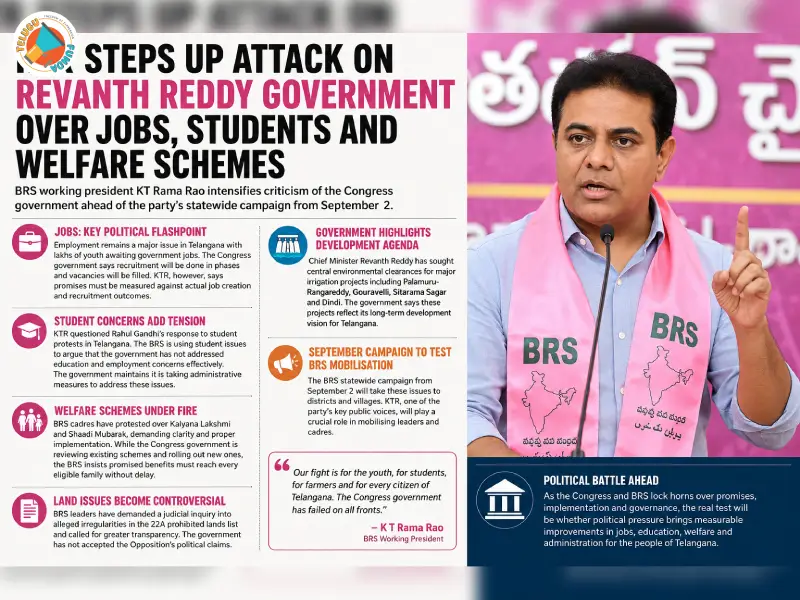
Hyderabad: Bharat Rashtra Samithi (BRS) working president KT Rama Rao has intensified his criticism of the Telangana government, targeting the Revanth Reddy administration over employment, student concerns, welfare schemes and the implementation of Congress’s election promises.

KTR’s latest attacks come ahead of the BRS’s statewide political campaign scheduled to begin on September 2. The party plans to take its criticism of the government to districts and villages, focusing on what it describes as failures in governance and delays in fulfilling key commitments.

Jobs Remain Key Political Flashpoint

Employment is emerging as one of the major points of confrontation between the BRS and Congress. With a large number of young people seeking government jobs, recruitment has remained a politically sensitive issue in Telangana.

The Congress government has maintained that vacant posts will be filled in phases. Chief Minister Revanth Reddy has also urged unemployed youth not to be influenced by political attempts to create unrest, while reiterating the government’s commitment to recruitment.

The BRS, however, argues that the government’s promises should be assessed against actual recruitment numbers and employment opportunities created for young people.

Student Issues Add to Political Tension

Student concerns have also become part of the growing political confrontation. KTR recently questioned Congress leader Rahul Gandhi over his response to student protests in Telangana.

The BRS is seeking to use such incidents to argue that the Congress government has failed to adequately address concerns related to education and employment. The government, meanwhile, has maintained that these issues are being addressed through administrative measures and policy initiatives.

Welfare Schemes Under Opposition Focus

Welfare programmes such as Kalyana Lakshmi and Shaadi Mubarak have emerged as another area of political disagreement. BRS leaders and cadres have held protests seeking clarity over the implementation and continuation of the schemes.

The programmes remain politically significant because they directly affect eligible families across the state. While the Congress government has been reviewing existing welfare programmes and pursuing its own welfare priorities, the BRS has been pressing the administration to ensure that promised benefits reach beneficiaries without delays.

Land Issues Become Another Battleground

Land administration has also come under Opposition scrutiny. BRS leaders have demanded a judicial inquiry into alleged irregularities linked to the 22A prohibited lands list and called for greater transparency in the process.

The issue has political and administrative significance as restrictions on land transactions can directly affect property owners and citizens. The government, however, has not accepted the Opposition’s political characterisation of the matter.

Government Highlights Development Agenda

While the BRS is focusing on governance-related criticism, the Congress government has been highlighting infrastructure, irrigation and development initiatives.

Revanth Reddy has also sought central environmental clearances for major irrigation projects, including Palamuru-Rangareddy, Gouravelli, Sitarama Sagar and Dindi. The government has positioned these projects as part of its broader development agenda for Telangana.

September Campaign to Test BRS Mobilisation

The BRS’s statewide campaign from September 2 is expected to bring these issues into sharper focus. KTR, one of the party’s key public voices, is likely to play a central role in mobilising party leaders and cadres.

The Congress is expected to counter the BRS campaign by highlighting its own implementation record, welfare initiatives and development programmes.

As the political battle intensifies, the contest is increasingly shifting from broad Congress-versus-BRS rhetoric to specific questions of governance and implementation. For voters, the key issue will be whether the political confrontation translates into measurable progress in jobs, education, welfare and administration.

The coming weeks could therefore prove important for both parties, with the BRS seeking to rebuild political momentum and the Congress government facing growing pressure to demonstrate results on its electoral commitments.

Follow Telugu Funda on trending Social Media Platforms for more Cinema, OTT, Political, And Sports updates.
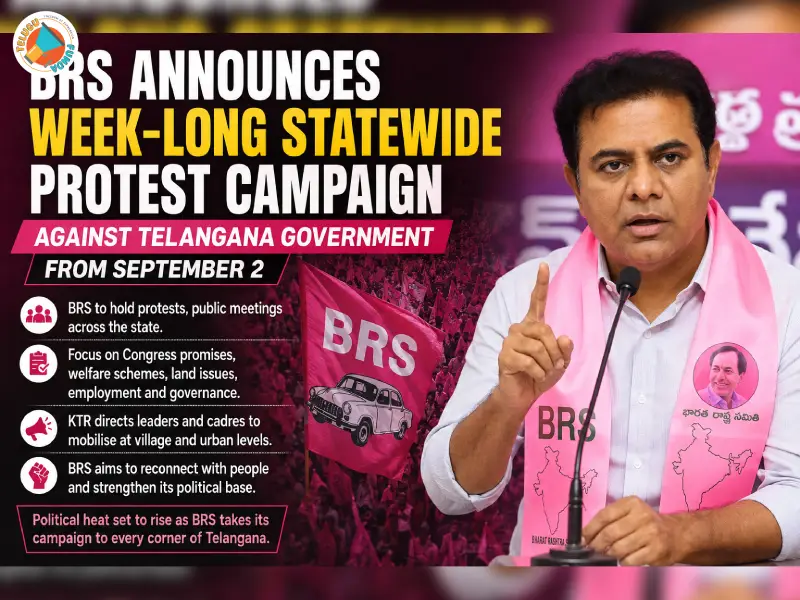
Hyderabad: The Bharat Rashtra Samithi (BRS) is set to launch a week-long statewide political campaign from September 2, targeting the Congress government in Telangana over what the Opposition party describes as unfulfilled election promises, welfare concerns and governance-related issues.

BRS working president K T Rama Rao (KTR) has directed party leaders and cadres to organise protests, public meetings and other programmes across the state. The campaign is aimed at taking the party’s political message to villages and urban centres while highlighting issues that the BRS says directly affect citizens.

The move marks another major effort by the BRS to strengthen its political and organisational presence in Telangana following its defeat in the 2023 Assembly elections. The Congress, led by Chief Minister A Revanth Reddy, came to power after ending the BRS’s decade-long rule in the state.

The implementation of Congress’s election promises is expected to be a key focus of the campaign. The BRS has repeatedly accused the government of failing to fulfil several commitments within the promised timeframe. Congress leaders, however, have rejected the allegations and maintained that the government is implementing its programmes while dealing with financial and administrative challenges.

Welfare Schemes Likely to Feature Prominently

Welfare implementation is expected to be another major issue during the BRS campaign. The party has recently organised protests in parts of Khammam and Kothagudem over concerns surrounding the implementation of Kalyana Lakshmi and Shaadi Mubarak schemes.

The BRS has sought to portray delays or gaps in welfare delivery as evidence of the Congress government’s alleged failure to meet its commitments. The ruling party, meanwhile, has maintained that it remains committed to welfare programmes while reviewing and restructuring various schemes.

Land Issues Add to Political Battle

Land administration is also emerging as a major point of confrontation between the two parties. BRS leaders have demanded a judicial inquiry into alleged irregularities involving Telangana’s 22A prohibited lands list.

Former minister T Harish Rao has sought a probe, a white paper and greater transparency over the issue. Land-related matters are politically sensitive as discrepancies in records can affect property ownership, transactions and the interests of landholders.

Focus on Youth, Students and Employment

The BRS is also expected to raise issues concerning students, young people and employment during the statewide campaign. The party has been questioning the government’s handling of student-related concerns and employment opportunities.

Chief Minister Revanth Reddy and Congress leaders have defended the government’s record, while emphasising development initiatives and employment-related measures as part of their broader vision for Telangana.

BRS Seeks to Regain Political Momentum

The September 2 campaign comes at a crucial time for the BRS as it seeks to rebuild its political momentum and strengthen its organisational network. Statewide programmes can provide Opposition parties with an opportunity to reconnect with grassroots cadres, highlight local concerns and assess public sentiment.

For the BRS, the campaign is also an attempt to reinforce its position as the principal Opposition force in Telangana and present an alternative political narrative to the Congress government.

The response to the protests could determine the political impact of the campaign. Strong public participation could increase pressure on the government over specific issues, while limited mobilisation could give the ruling Congress an opportunity to question the BRS’s public support.

With welfare, employment, land administration, election promises and development emerging as key areas of political confrontation, the BRS campaign is likely to intensify the ongoing battle between the ruling Congress and the Opposition in Telangana.

Follow Telugu Funda on trending Social Media Platforms for more Cinema, OTT, Political, And Sports updates.
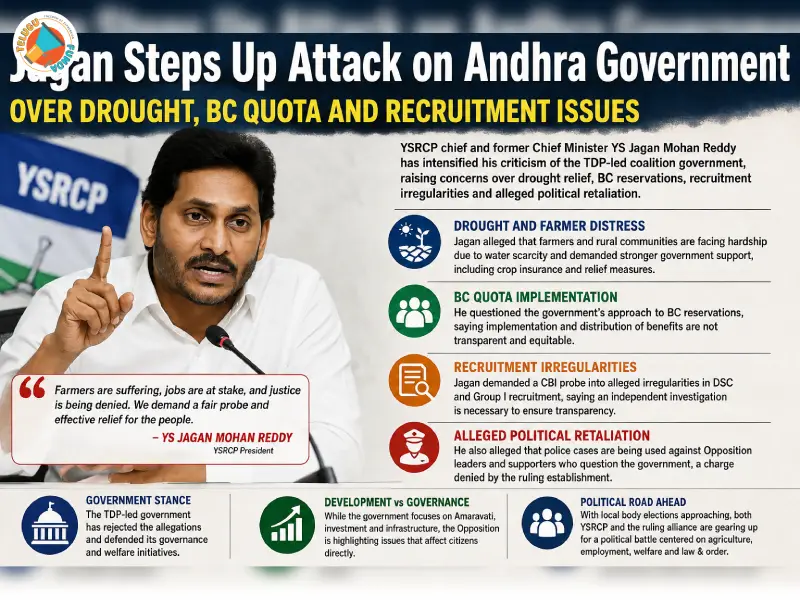
Amaravati: YSR Congress Party (YSRCP) president and former Andhra Pradesh Chief Minister YS Jagan Mohan Reddy has intensified his criticism of the TDP-led coalition government, raising concerns over drought relief, Backward Classes (BC) reservations, recruitment procedures and alleged political retaliation against Opposition supporters.

Jagan has recently targeted the government over the drought situation in parts of Andhra Pradesh, stating that farmers and rural communities need stronger support. The YSRCP has called for effective measures to address water shortages, crop-related concerns, insurance support and relief for affected farming communities.

The government, however, has maintained that it is taking necessary steps to address agricultural and welfare-related challenges. The dispute has largely centred on the adequacy and implementation of relief measures, with both sides presenting contrasting political narratives.

BC Reservation Becomes Key Political Issue

The implementation of BC quota-related measures has also emerged as a major point of contention. Jagan has questioned aspects of the government’s approach, while the ruling coalition has sought to project itself as committed to strengthening BC representation.

With Backward Classes forming a significant section of Andhra Pradesh’s electorate, reservation and representation issues carry considerable political importance. The implementation and distribution of benefits are therefore likely to remain under close scrutiny.

YSRCP Raises Questions Over Recruitment

Public recruitment is another major issue being highlighted by the Opposition. Jagan has demanded a CBI investigation into alleged irregularities in DSC and Group I recruitment, arguing that an independent probe is needed to establish whether any wrongdoing took place.

The issue has attracted attention among job aspirants and unemployed youth across the state. Teacher recruitment, in particular, remains politically sensitive because of the large number of candidates involved and its impact on government education.

The YSRCP has sought to use the recruitment controversy to question the government’s handling of selection procedures, while the ruling establishment has rejected the Opposition’s political allegations and defended its governance record.

Political Tensions Continue

Jagan has also alleged that police cases are being used against Opposition leaders and supporters who criticise the government. The ruling side has disputed these allegations, adding to the wider political confrontation between the TDP-led coalition and YSRCP.

The TDP coalition came to power following the 2024 Assembly elections, while the YSRCP was reduced to a much smaller presence in the state Assembly. Since then, the Opposition has been attempting to rebuild its organisational strength and regain political momentum by focusing on issues affecting citizens directly.

Drought and Employment Likely to Remain Key Issues

Agriculture remains a crucial political issue in Andhra Pradesh, given the state’s large rural population and dependence on irrigation and seasonal rainfall. Prolonged water shortages can have a direct impact on crop production, household incomes and rural employment.

Similarly, government recruitment is expected to remain a major concern among young people. Protests, recruitment disputes and demands for transparency could continue to put pressure on the government.

At the same time, the coalition government is highlighting its development agenda, including Amaravati, infrastructure expansion, industrial investment and long-term economic growth plans.

This has created two contrasting political narratives in the state: the government’s emphasis on development and future investment, and the Opposition’s focus on immediate governance, employment, agriculture and welfare concerns.

The political debate is expected to intensify as Andhra Pradesh moves towards local body elections. While the YSRCP will seek to strengthen its grassroots network, the ruling alliance will look to consolidate the political advantage gained in the 2024 Assembly elections.

Issues including agriculture, employment, BC reservations, welfare delivery and law and order are likely to remain central to the political contest in the months ahead.

Follow Telugu Funda on trending Social Media Platforms for more Cinema, OTT, Political, And Sports updates.
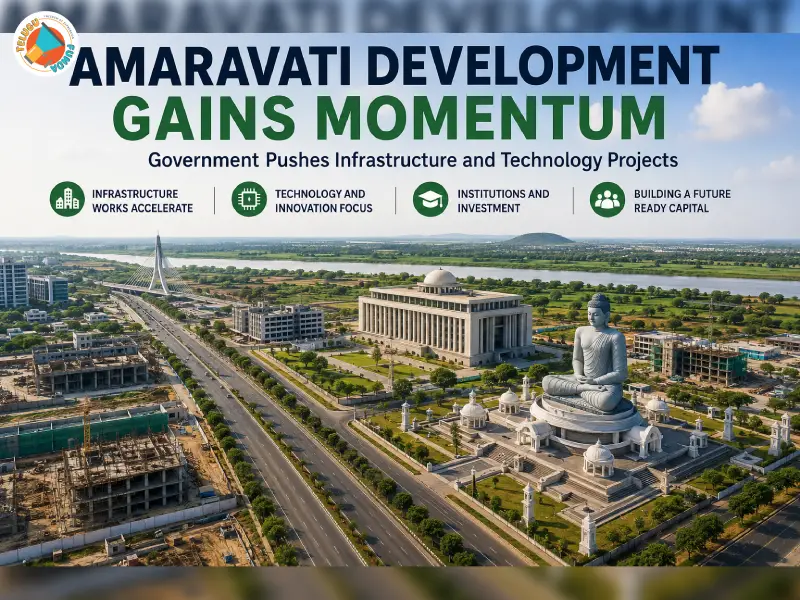
Amaravati: Development activity in Amaravati is gathering pace as the Andhra Pradesh government steps up infrastructure works and seeks to establish the capital region as a major economic, educational and technology hub.

Chief Minister N Chandrababu Naidu has directed officials to accelerate efforts to develop Amaravati as a key economic growth centre for the state. At a recent AP Capital Region Development Authority (APCRDA) meeting, officials reviewed ongoing works and plans for the development of the capital city.

The government’s current strategy covers infrastructure construction, urban planning, public services, technology projects and measures to attract institutions and private investment.

Infrastructure Works Gain Momentum

The APCRDA has been issuing tenders for infrastructure-related works across several villages in the Amaravati capital city area. Recent tenders have covered locations including Nidamarru, Neerukonda, Bethapudi, Kuragallu, Venkatapalem, Undavalli, Nekkallu and Thulluru.

These projects form part of the broader effort to establish the basic infrastructure required for the planned capital, including roads, utilities and other essential urban facilities.

The authority has also been pursuing projects related to urban services, energy infrastructure and quality-assurance mechanisms for construction and development works.

Technology Push Takes Centre Stage

Alongside physical infrastructure, the government is seeking to give Amaravati a stronger technology and innovation identity.

One of the major proposals is the establishment of a National Institute of Electronics and Information Technology (NIELIT) campus, involving an investment of around Rs 730.7 crore. The institution is expected to contribute to the emerging technology ecosystem, with areas such as artificial intelligence and quantum technologies receiving particular attention.

The government has indicated that Amaravati should not be developed merely as an administrative capital but should also emerge as a centre for deep technology, innovation, education and research.

Such an ecosystem could help attract universities, research institutions, startups and technology companies while creating opportunities for skilled employment.

Land and Compensation Remain Key Issues

Land continues to be one of the most sensitive aspects of Amaravati’s development. Thousands of farmers and landowners are connected to the capital region project, making land management and compensation important components of the government’s plans.

A recent decision to fix a rate of Rs 10.25 crore per acre for additional land in Amaravati is expected to have implications for future land acquisition and negotiations with landowners.

The government will need to balance infrastructure requirements with the interests of landowners as construction activity expands.

Focus on Global Expertise and Urban Design

The government is also looking to international expertise for Amaravati’s urban development. Recent developments indicate cooperation involving UK expertise in urban development-related areas.

At the same time, the government has spoken about creating a distinct identity for Amaravati through architecture and urban design that reflects Telugu culture while incorporating modern urban-planning principles.

From Capital Project to Economic Ecosystem

Amaravati’s development has been under discussion for more than a decade and has gone through significant political and policy changes. The present government has reaffirmed Amaravati as Andhra Pradesh’s capital and is seeking to accelerate the project.

However, transforming the region into a fully functional capital will require substantial investment in transport, water supply, drainage, power, housing, public services and commercial infrastructure.

Amaravati’s location between Vijayawada and Guntur provides an existing urban and transportation network that could support the expansion of the capital region.

Political Debate Continues

For the ruling coalition, Amaravati represents both a major governance initiative and a political commitment. The Opposition, meanwhile, continues to raise questions regarding the cost, pace and implementation of the capital project.

Despite the political debate, the increase in tenders, infrastructure activity and institutional proposals indicates movement from long-term planning towards implementation in several areas.

The next phase will be crucial, with the government expected to focus on completing infrastructure packages, attracting private investment and bringing educational and technology institutions to the region.

If these plans are implemented effectively, Amaravati could gradually evolve beyond an administrative capital into a broader economic, educational and technology centre for Andhra Pradesh.

For now, the government’s priority remains clear: build the physical infrastructure, establish key institutions and create the foundations for a long-term economic ecosystem in Amaravati.

Follow Telugu Funda on trending Social Media Platforms for more Cinema, OTT, Political, And Sports updates.

Recent Posts

Categories