
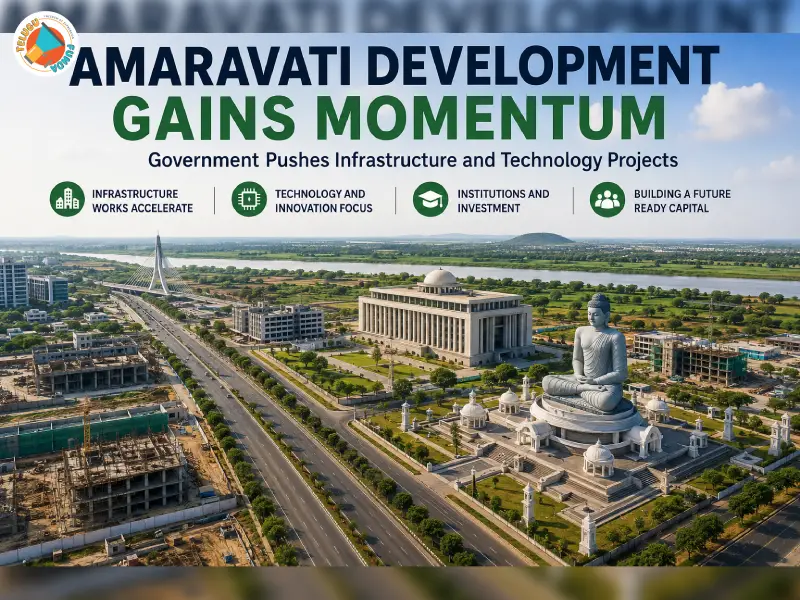
Amaravati: Development activity in Amaravati is gathering pace as the Andhra Pradesh government steps up infrastructure works and seeks to establish the capital region as a major economic, educational and technology hub.
Chief Minister N Chandrababu Naidu has directed officials to accelerate efforts to develop Amaravati as a key economic growth centre for the state. At a recent AP Capital Region Development Authority (APCRDA) meeting, officials reviewed ongoing works and plans for the development of the capital city.
The government’s current strategy covers infrastructure construction, urban planning, public services, technology projects and measures to attract institutions and private investment.
Infrastructure Works Gain Momentum
The APCRDA has been issuing tenders for infrastructure-related works across several villages in the Amaravati capital city area. Recent tenders have covered locations including Nidamarru, Neerukonda, Bethapudi, Kuragallu, Venkatapalem, Undavalli, Nekkallu and Thulluru.
These projects form part of the broader effort to establish the basic infrastructure required for the planned capital, including roads, utilities and other essential urban facilities.
The authority has also been pursuing projects related to urban services, energy infrastructure and quality-assurance mechanisms for construction and development works.
Technology Push Takes Centre Stage
Alongside physical infrastructure, the government is seeking to give Amaravati a stronger technology and innovation identity.
One of the major proposals is the establishment of a National Institute of Electronics and Information Technology (NIELIT) campus, involving an investment of around Rs 730.7 crore. The institution is expected to contribute to the emerging technology ecosystem, with areas such as artificial intelligence and quantum technologies receiving particular attention.
The government has indicated that Amaravati should not be developed merely as an administrative capital but should also emerge as a centre for deep technology, innovation, education and research.
Such an ecosystem could help attract universities, research institutions, startups and technology companies while creating opportunities for skilled employment.
Land and Compensation Remain Key Issues
Land continues to be one of the most sensitive aspects of Amaravati’s development. Thousands of farmers and landowners are connected to the capital region project, making land management and compensation important components of the government’s plans.
A recent decision to fix a rate of Rs 10.25 crore per acre for additional land in Amaravati is expected to have implications for future land acquisition and negotiations with landowners.
The government will need to balance infrastructure requirements with the interests of landowners as construction activity expands.
Focus on Global Expertise and Urban Design
The government is also looking to international expertise for Amaravati’s urban development. Recent developments indicate cooperation involving UK expertise in urban development-related areas.
At the same time, the government has spoken about creating a distinct identity for Amaravati through architecture and urban design that reflects Telugu culture while incorporating modern urban-planning principles.
From Capital Project to Economic Ecosystem
Amaravati’s development has been under discussion for more than a decade and has gone through significant political and policy changes. The present government has reaffirmed Amaravati as Andhra Pradesh’s capital and is seeking to accelerate the project.
However, transforming the region into a fully functional capital will require substantial investment in transport, water supply, drainage, power, housing, public services and commercial infrastructure.
Amaravati’s location between Vijayawada and Guntur provides an existing urban and transportation network that could support the expansion of the capital region.
Political Debate Continues
For the ruling coalition, Amaravati represents both a major governance initiative and a political commitment. The Opposition, meanwhile, continues to raise questions regarding the cost, pace and implementation of the capital project.
Despite the political debate, the increase in tenders, infrastructure activity and institutional proposals indicates movement from long-term planning towards implementation in several areas.
The next phase will be crucial, with the government expected to focus on completing infrastructure packages, attracting private investment and bringing educational and technology institutions to the region.
If these plans are implemented effectively, Amaravati could gradually evolve beyond an administrative capital into a broader economic, educational and technology centre for Andhra Pradesh.
For now, the government’s priority remains clear: build the physical infrastructure, establish key institutions and create the foundations for a long-term economic ecosystem in Amaravati.
Follow Telugu Funda on trending Social Media Platforms for more Cinema, OTT, Political, And Sports updates.