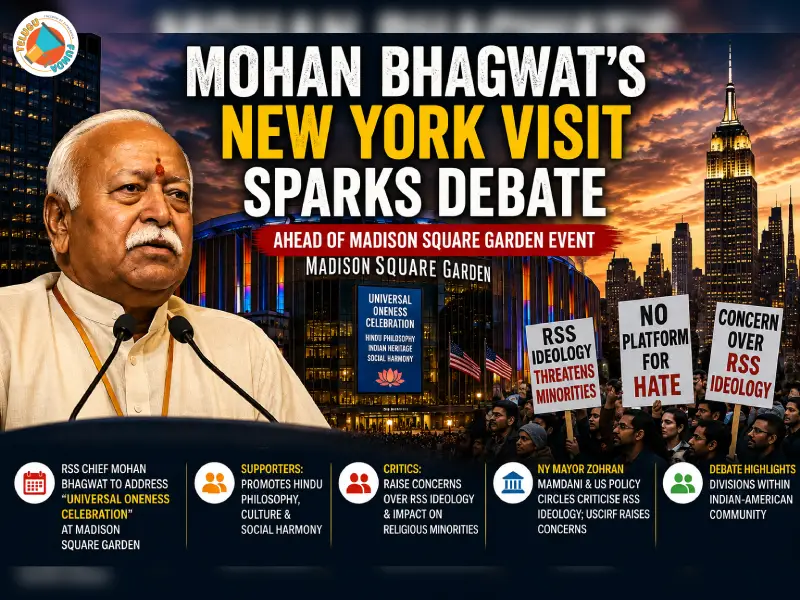
New York: Rashtriya Swayamsevak Sangh (RSS) chief Mohan Bhagwat’s planned appearance at Madison Square Garden has sparked a debate among sections of the Indian-American community, civil society groups and interfaith organisations.
Bhagwat is scheduled to address the “Universal Oneness Celebration”, organised by American Hindus for Engagement and Dialogue. Organisers are expecting a large turnout for the programme, which they have presented as an event centred on Hindu philosophy, Indian cultural heritage and social harmony.
However, Bhagwat’s planned appearance has drawn criticism because of the RSS’s ideological and political significance in India. The organisation is widely seen as an influential force within the country’s broader Hindu nationalist movement and has maintained close ideological links with the Bharatiya Janata Party (BJP).
Supporters of the event say Bhagwat’s visit represents an opportunity to highlight India’s cultural traditions and promote the message of social unity among the diaspora. They argue that the RSS and its leadership should have the space to engage with Indian-American audiences, particularly given the organisation’s prominence in contemporary Indian society.
Opponents, meanwhile, have questioned the RSS’s ideological positions and raised concerns about its influence on religious minorities in India. The criticism has extended to sections of civil society and interfaith groups in New York.
New York Mayor Zohran Mamdani has also publicly criticised the RSS’s ideology, adding another dimension to the controversy. The issue has further attracted attention within US policy circles, with the US Commission on International Religious Freedom reportedly raising concerns over Bhagwat’s visit and making suggestions involving his visa and possible measures against RSS members.
The RSS and supporters of the programme have rejected allegations that the organisation is anti-minority. They maintain that its work is centred on cultural identity, social service, national unity and strengthening society.
The dispute has consequently developed into a wider discussion about the role of Indian political, cultural and religious organisations within the United States. The Indian-American community is one of the country’s most prominent South Asian diaspora groups, and organisations representing a wide range of political and ideological viewpoints regularly organise public events.
Bhagwat’s proposed appearance has brought divisions within the diaspora into sharper focus, particularly over the interpretation of Hindu identity and the political role of organisations associated with it.
Supporters contend that the RSS reflects an important segment of Indian society and that its leaders should be able to engage with diaspora communities. Critics, on the other hand, argue that prominent US platforms should not be used to legitimise an ideology they associate with religious majoritarianism.
The controversy also reflects broader debates in the United States over political expression, religious identity, civil rights and the growing influence of diaspora organisations.
Bhagwat’s position as RSS chief has added to the significance of the event. His public appearances are closely watched both in India and overseas, and the Madison Square Garden programme is being viewed as an important moment for supporters as well as critics.
For organisers, the event is an opportunity to promote Hindu traditions and the principle of universal oneness. For opponents, it provides a platform to question the ideology and social influence associated with the RSS.
As the programme approaches, attention is likely to remain focused on attendance, Bhagwat’s remarks and the response from different sections of the Indian-American community. The controversy highlights how India’s domestic political and ideological debates increasingly extend beyond its borders, particularly through politically diverse and highly engaged diaspora communities.
Follow Telugu Funda on trending Social Media Platforms for more Cinema, OTT, Political, And Sports updates.